Three-Wattled Bellbird in Monteverde — Sunrise Birdwatching in Curi-Cancha Reserve
The three-wattled bellbird produces one of the loudest and most extraordinary calls in the bird world — a metallic hammering ring that carries for kilometres through the Monteverde cloud forest. This sunrise birdwatching tour in Curi-Cancha Reserve is one of the best ways to see the bellbird perched and calling in the canopy. Early morning light, peak bird activity, and an expert naturalist guide combine to make this one of the most memorable wildlife experiences in Costa Rica. Browse all guided birdwatching tours in Monteverde we cover — sunrise sessions and longer half-day walks.
About This Activity
Up to 24h in advance — full refund
Peak bird activity — best photography light
Expert guide + binoculars included
Guide targets known bellbird perch sites
Essential for bellbird canopy views
Highest-rated sunrise tour in Monteverde
Check Live Availability & Prices
Real-time dates and prices — free cancellation up to 24 hours before.
The Three-Wattled Bellbird — What Makes It Extraordinary
Costa Rica's Loudest Bird
The three-wattled bellbird (Procnias tricarunculatus) is one of the loudest birds on earth, with a call measured at over 100 decibels at close range — louder than a chainsaw. The male produces a sharp, resonant metallic ring that echoes through the cloud forest canopy, audible from over a kilometre away. The male's name comes from the three worm-like wattles that hang from the base of the bill — a striking and deeply unusual feature that makes it one of the most distinctive birds in the Americas.
- Call volume exceeds 100 dB — among the loudest bird calls on earth
- Three wattles hanging from the bill base — unique among Costa Rican birds
- Chestnut and white plumage — distinctive at any distance
- Perches on exposed emergent tree tops — easier to spot than forest-interior species
- Active caller from March to July during mating season
Why Curi-Cancha at Sunrise Is the Best Strategy
The bellbird is most active in the first hours after dawn. During mating season (March to July), males perch on exposed treetops and call repeatedly to attract females — choosing the same perch sites day after day. A guide who knows these sites can position the spotting scope before the bird arrives.
Curi-Cancha's quiet trails mean you hear the bird before you see it, allowing you to approach without flushing it from the perch.
What You'll See on the Sunrise Birdwatching Tour
The Bellbird and the Quetzal — Two Headline Species
Curi-Cancha at sunrise gives you a genuine chance of seeing both the three-wattled bellbird and the resplendent quetzal on the same morning. Quetzals feed on aguacatillo fruits in the early morning light; bellbirds perch and call on exposed canopy emergents. Your guide sequences the route to maximize time at both species' key locations.
- Three-wattled bellbird — guide targets known canopy perch sites
- Resplendent quetzal — feeding and nesting areas covered on the same loop
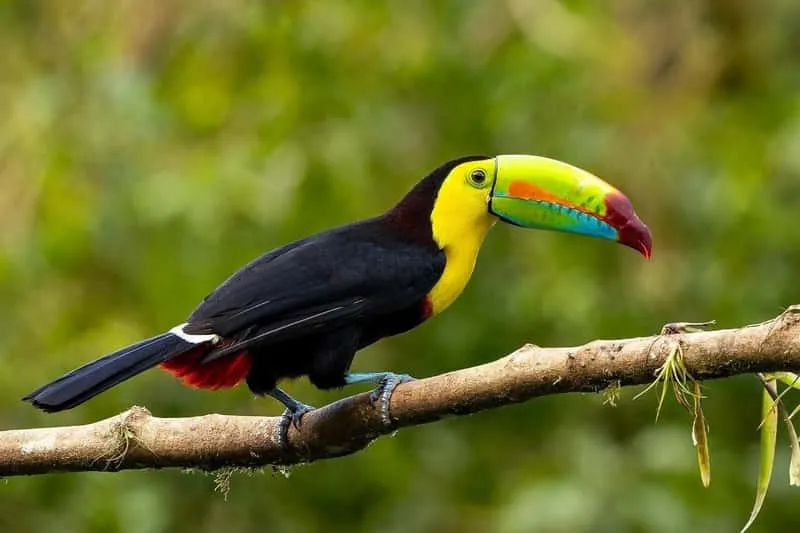
- Emerald toucanet and keel-billed toucan common in the upper reserve
- Multiple hummingbird species at flowering plants along the trail
Sunrise Light for Photography
The sunrise start is not only about bird activity — the golden-hour light filtering through the cloud forest creates exceptional conditions for photography. Backlit mist, warm tones on bird plumage, and the clarity of the morning air before clouds build produce images that are difficult to replicate at any other time of day. Bring a camera and a telephoto lens; the guide will advise on positioning.
- Golden-hour light from 6–7am — ideal for bird photography
- Backlit mist creates atmospheric forest shots
- Bellbird on canopy perch against bright sky — classic shot
- Quetzal in laurel tree — guide positions you for unobstructed angle
What's Included, What to Bring, What's Not Allowed
What's Included
- Expert English-speaking naturalist guide
- Binoculars for the duration of the tour
- Spotting scope for bellbird and quetzal views
- Species identification throughout the walk
- Free cancellation up to 24 hours before
Not Included
- Curi-Cancha Reserve entrance fee (approximately $15 — paid at the gate)
- Transport to the reserve (ask your accommodation for early-morning options)
- Breakfast (there are cafés near the reserve that open early)
- Guide gratuity (optional — $5 to $10 per person)
What to Bring
- Camera with a telephoto lens — 200mm minimum, 400mm ideal for bellbird shots
- Light waterproof jacket — sunrise mist is common year-round
- Warm layer — Monteverde mornings can be cool even in dry season
- Water and a light snack (the tour starts before most restaurants open)
- Insect repellent
- Head torch or phone light — the reserve can be dark at the start of the tour
Not Allowed
- Flash photography — disturbs wildlife and prohibited in the reserve
- Loud conversations or noise on trails — critical near the bellbird's perch
- Leaving marked trails
- Bringing pets into the reserve
Sunrise Tour — Step by Step
-
05:30–06:00
Meet your guide at the reserve entrance
Meet before dawn at the agreed point near Curi-Cancha Reserve. Exact meeting time varies by season — your guide confirms after booking. The earlier the start, the better the bellbird conditions.
-
06:00–06:30
Enter the reserve at first light
The reserve opens at dawn. Your guide leads you in silence toward the bellbird's known perch sites. The hammering call often starts before full light — listen for it from the trail.
-
06:30–07:30
Bellbird and quetzal search — peak activity window
The guide positions the scope at the bellbird's canopy perch. If the bird is calling, you locate it immediately by sound. Quetzal feeding trees are covered on the same loop during this window.
-
07:30–08:30
Full forest walk — hummingbirds, tanagers, trogons
After the headline species, the tour continues through the lower reserve for the full range of cloud forest birds. Morning light is still golden; bird activity remains high.
-
08:30–09:00
Exit and species review
Return to the gate and review the morning's list. Your guide will discuss any species you want to learn more about and suggest afternoon or next-day birding options.
Important Things to Know
When Is the Bellbird Present in Monteverde?
The three-wattled bellbird is altitudinal — it moves between the cloud forest and lowland areas depending on the season. In Monteverde, bellbirds are present and calling from approximately March through July during mating season. Outside these months, bellbirds are far less common and the call is rarely heard.
If seeing the bellbird is your priority, plan your visit between March and July.
What If It's Cloudy or Rainy?
Cloud forest mist and light rain are normal in Monteverde year-round and do not affect birdwatching significantly — the bellbird calls regardless of light conditions, and the quetzal feeds in light rain. Heavy rain can temporarily suppress bird activity, but it rarely lasts all morning. Free cancellation applies up to 24 hours before if conditions are severe.
Bellbirds are altitudinal migrants, reported in Monteverde roughly March to July with the loudest calling most often in May and June, so this tour is seasonal in a way the reserve walks are not. Plan the month with our best time for birdwatching guide and the arrival with getting to Monteverde.
Location: Curi-Cancha Reserve, Monteverde, Costa Rica
Who This Tour Is For
Perfect For
- Birdwatchers who specifically want to see or hear the three-wattled bellbird
- Photographers wanting golden-hour light and a guide who knows bellbird perch locations
- Early risers who want to start birding at dawn when activity peaks
- Visitors combining this with an afternoon activity — the 2.5-hour format leaves the day free
Not Suitable For
- Visitors visiting outside March to July who need to see the bellbird (it may be absent)
- Anyone who cannot manage a 6am or earlier start — the sunrise format requires an early commitment
- Those with mobility limitations — Curi-Cancha's trails involve uneven forest terrain
- Visitors expecting large group tours — this is a small group, quiet experience
Three-Wattled Bellbird Tour — FAQ
Where exactly is the three-wattled bellbird found in Monteverde?
In Monteverde, bellbirds favor the upper cloud forest zone, particularly Curi-Cancha Reserve and the Monteverde Cloud Forest Biological Reserve. During mating season the males perch on emergent tree tops above the main canopy — exposed, distinctive perches that carry the call over long distances. Your guide knows the specific trees used most frequently.
How loud is the bellbird's call in person?
Very loud — most visitors describe it as startling the first time they hear it close up. The call carries for over a kilometre through the forest; if the bird is within 50 metres, the sound is genuinely extraordinary. Hearing it for the first time is one of the most memorable wildlife moments Costa Rica offers, even for visitors who are not primarily birdwatchers.
Is this tour only about the bellbird, or will we see other species?
This tour covers the full range of Curi-Cancha's cloud forest birds, with the bellbird as the headline target. A typical morning produces 25 to 40 species including the resplendent quetzal, multiple tanager species, hummingbirds, trogons, and forest specialists. The bellbird is the focus but not the only bird of the morning.
What time does the tour start?
The sunrise tour starts at or before dawn — typically around 5:30 to 6:00am depending on the season and the current sunrise time. Your guide will confirm the exact start time after booking. This early start is non-negotiable for peak bellbird activity.
Can I combine this with the quetzal tour on the same day?
This sunrise tour already targets the quetzal alongside the bellbird — both are covered in the Curi-Cancha route. If you want extended quetzal time, the dedicated quetzal tour (2.5 hours, from $45) can be done on a separate morning. The guide can advise which combination gives you the best chance of both species based on current sighting reports.
What Travelers Say About the Sunrise Bellbird Tour
The bellbird call was absolutely extraordinary — I heard it before we even entered the reserve and couldn't believe the volume. When we got the scope on it in the tree top, it was one of the most surreal wildlife moments of my life.
Sunrise in Curi-Cancha was magical. Mist in the trees, golden light, bellbird calling from the canopy. We also saw a quetzal on the same walk. Our guide was exceptional — found both species within the first hour.
I travel specifically for birds and this was one of the best guided tours I've had anywhere in the world. The guide's knowledge of the reserve was extraordinary and the scope views of the bellbird were incredible.